What the Land Is Trying to Feed You: A Nomad's Guide to Reading the Wild
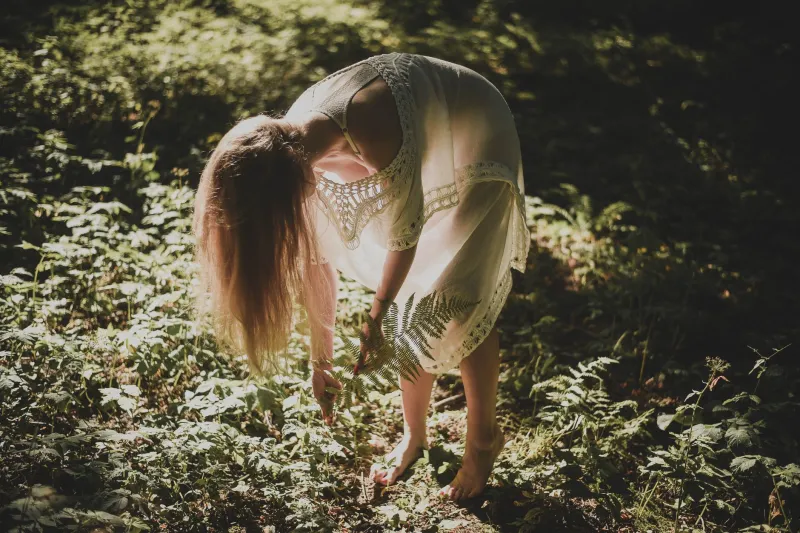
There's a moment that every serious forager talks about. It happens differently for everyone — maybe you're crouched beside a creek somewhere in the Blue Ridge Mountains, or wandering the scrubby edge of a California coastal bluff — but the feeling is the same. The landscape stops being scenery. It becomes a sentence you're finally learning to read.
For a growing wave of nomads, van-dwellers, and itinerant free spirits moving across the American landscape, that shift in perception is becoming one of the most profound parts of life on the road. Call it wildcrafting. Call it foraging. Call it ethnobotany for the restless. Whatever name you give it, the practice is ancient, deeply practical, and — maybe most surprisingly — one of the most powerful ways wanderers have found to feel genuinely connected to the places they pass through.
The Original Convenience Store
Let's be honest about what most road food looks like. Gas station roller dogs. Sad highway-exit fast food. That one granola bar you've been saving since New Mexico. Living on the road is freedom in a thousand ways, but the food situation can feel like a compromise you've quietly agreed to endure.
Foraging blows that compromise apart.
When you start learning to identify edible plants — purslane sprawling across a dusty trailhead parking lot, wood sorrel threading through a shaded campsite, watercress crowding a cold spring — the landscape restructures itself around you. Suddenly, every stop is also a pantry. Every hillside is a medicine cabinet. Every roadside ditch is a conversation waiting to happen.
Samara Voss, a nomadic herbalist who has been traveling the American Southwest and Pacific Northwest for six years, describes the shift as irreversible. "Once you see it, you can't unsee it," she says. "I'll pull into a new campsite and before I even set up my bed, I'm doing a slow walk, just looking. What's here? What does this place have to offer? It completely changes how you arrive somewhere."
That arrival — intentional, observational, quiet — sounds a lot like the kind of presence most of us are chasing when we hit the road in the first place.
Rooted by Moving
Here's the paradox at the heart of wildcrafting culture: a practice that seems to require staying put is actually teaching nomads how to belong everywhere.
Traditional foraging knowledge is deeply regional. Ramps grow in Appalachian hollows. Prickly pear pads are a Sonoran Desert staple. Miner's lettuce carpets the Pacific Coast in early spring. Learning to forage means learning the specific logic of each landscape — its seasonal rhythms, its water patterns, its microclimates and soil personalities.
For someone always moving, that's not a limitation. It's an invitation to pay attention in a way that tourism never demands.
"I've been to Sedona three times," says Devin Calloway, who travels full-time in a converted Sprinter van and has been studying plant medicine for four years. "But the first two times I was just taking pictures and hitting the vortex spots. The third time, I actually knew what I was looking at on the ground. I knew what was edible, what was medicinal, what the Indigenous peoples of that area had used for centuries. The place became completely three-dimensional."
This is the spiritual dimension of foraging that doesn't get talked about enough in the practical guides and YouTube tutorials. It's not just about free food. It's about developing a relationship with place that goes below the surface — literally and figuratively.
Learning the Language (Without Getting Yourself Killed)
Okay, real talk: foraging has a learning curve, and some of that curve involves not accidentally poisoning yourself. This is not a reason to avoid it. It is a reason to approach it with humility, patience, and good mentorship.
The nomadic foraging community has developed some solid entry points for beginners. Here's what the experienced wildcrafters consistently recommend:
Start with the unmistakables. Some plants are so distinctive that misidentification is nearly impossible — dandelion, cattail, blackberry, elderberry (though note: elder flowers and ripe berries are safe, other parts are not). Build your confidence here before moving into trickier territory.
Get regional field guides. A guide written for the Pacific Northwest is going to be far more useful than a general North American overview when you're camping outside of Ashland, Oregon. Samuel Thayer's books are widely respected. Euell Gibbons remains a classic. Thomas Elpel's Botany in a Day is beloved by the van life crowd for its pattern-based approach.
Find a human teacher. Apps can help you narrow things down, but experienced foragers are irreplaceable. Look for local wildcrafting walks, herbalism schools, and community foraging groups — they exist in nearly every region of the country and are often welcoming to travelers passing through.
Learn the poisonous plants first. Know your local toxic lookalikes before you start harvesting. In the Southeast, that means knowing poison hemlock. In the Pacific Northwest, it means understanding the difference between edible and toxic berries. Respect the danger without being paralyzed by it.
The Medicine Cabinet Under Your Feet
Beyond food, wildcrafting opens up a whole dimension of plant medicine that nomads are increasingly drawn to — partly for practical reasons (healthcare on the road is complicated and expensive) and partly for something harder to name.
Mullein for respiratory support grows along roadsides across most of the United States. Yarrow, one of the oldest wound herbs in the world, pops up in disturbed soils from coast to coast. Plantain — the broad-leafed weed, not the banana — is a remarkable first-aid plant that's almost certainly growing within fifty feet of wherever you're parked right now.
Samara keeps what she calls a "road apothecary" — a small wooden box of dried herbs, tinctures, and salves, most of which she's harvested and prepared herself over the course of her travels. "It's not about rejecting modern medicine," she's careful to say. "It's about not being helpless. It's about having a relationship with healing that doesn't require a pharmacy on every corner."
For nomads navigating the gaps and uncertainties of life outside conventional systems, that kind of self-sufficiency carries deep emotional weight.
The Deepest Freedom
There's something quietly radical about a person who can pull off the highway into an unfamiliar stretch of land and know — genuinely know — that they can feed themselves from what's growing there. Not as a survival stunt. Not as content for social media. Just as a simple, embodied fact of life.
The wandering life is often described in terms of what you're leaving behind — the cubicle, the commute, the mortgage, the routine. But foraging points toward something different. It's about what you're moving toward: a quality of attention, a depth of relationship with the living world, a kind of knowledge that no amount of money can buy and no algorithm can replicate.
The land has always been trying to feed us. It's been trying to heal us. It's been leaving clues in every ditch and meadow and creek bank across this vast, strange, beautiful country.
You just have to slow down long enough to learn how to look.