Glorious Disorder: How Letting Your Space Breathe Unlocks the Life You Actually Want
Somewhere between the tenth organizational bin and the third Marie Kondo rewatch, a lot of us started to wonder: is this actually making me happier?
The answer, for a growing number of bohemian travelers, artists, and unconventional livers, is a firm and liberating no.
There's a cultural obsession in the US right now with curated minimalism — the kind that floods your Instagram feed with white walls, single succulents, and the implication that if you just owned fewer things and arranged them more precisely, your life would finally click into place. It's a seductive story. It's also, for a lot of creative souls, complete nonsense.
Because here's what nobody in the organization aisle at Target is telling you: mess, when it belongs to you, when it carries your fingerprints and your history and your half-finished ideas, is one of the most powerful creative environments a human being can inhabit.
The Psychology of Creative Clutter
Let's get a little science-y for a second — not in a boring way, I promise.
Researchers at the University of Minnesota ran a study that found people working in disordered environments were significantly more likely to generate creative, outside-the-box ideas than those working in tidy ones. The clean-room folks? They played it safe. The messy-room crew? They took risks. They made unexpected connections. They surprised themselves.
That's not a fluke. That's your environment talking to your brain, giving it permission to wander.
Now layer that onto the bohemian lifestyle — a way of living that's never really been about rules in the first place — and you start to understand why so many artists, wanderers, and free spirits feel suffocated the moment someone hands them a label maker.
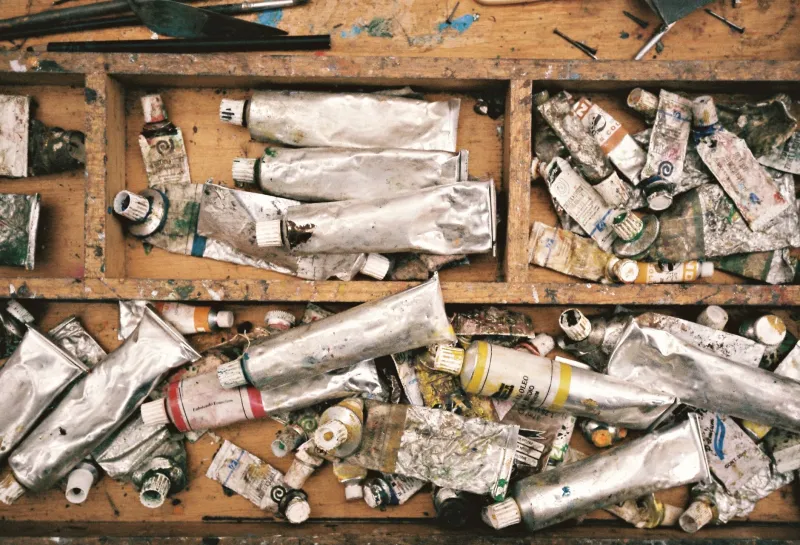
Rio, a muralist and part-time van dweller based out of New Mexico, puts it simply: "Every time I've tried to 'get organized,' I've stopped making things. My best work comes out of chaos. I need to see all of it — the paint tubes, the sketches, the random fabric scraps. If it's in a box, it doesn't exist to me anymore."
The Difference Between Sacred Mess and Suffocating Disorder
Okay, real talk — there's a distinction worth making here, because this isn't a permission slip to stop doing dishes for six months.
Creative clutter is alive. It has momentum. It's the open sketchbook next to three different pens because you weren't sure which felt right. It's the stack of paperbacks with receipts and ticket stubs shoved between pages. It's the van floor covered in trail maps and sunflower seed shells after a long drive through Utah.
Paralyzing disorder is different. It's the kind of mess that makes you feel ashamed when someone knocks on your door. The kind that makes you lose things and feel helpless. That's not sacred — that's stuck.
The bohemian approach isn't about glorifying dysfunction. It's about rejecting the idea that your kind of order has to look like anyone else's. Wanderers know this instinctively. When you're living out of a pack or a van or a rented room in a city you're only staying in for three weeks, you develop a deeply personal relationship with your belongings. You know exactly where everything is — even if it looks like chaos to an outsider.
That intimacy with your own stuff? That's the magic.
What the Minimalism Industry Doesn't Want You to Know
Here's the uncomfortable truth: the organizational product industry in America is worth billions of dollars. The aesthetic of minimalism — clean, sparse, controlled — has been monetized into an endless loop of purchase, declutter, re-purchase.
You buy the bins. You sort the things. You feel briefly satisfied. Then life happens, the bins fill up, and you feel like a failure. So you buy more bins.
It's a cycle that profits from your shame.
Jasmine, a textile artist and traveling flea market vendor who splits her time between Asheville, NC and the road, laughed when I brought this up. "I used to spend so much money trying to make my space look like a Pinterest board," she said. "Now I spend that money on fabric and road trips. My studio looks like a tornado hit it. I've never been more productive."
What Jasmine figured out — what a lot of bohemian creatives figure out eventually — is that the goal was never really tidiness. The goal was control. And control, when it becomes compulsive, is the enemy of creativity.
Your Space as a Self-Portrait
Here's the reframe that might actually change something for you: what if your space wasn't something to be managed, but something to be read?
Every object in your orbit tells a story. The guitar with the broken string you keep meaning to fix. The postcard from a stranger you met at a campsite in Colorado. The three journals — one for ideas, one for feelings, one for lists that never get finished. These things aren't clutter. They're evidence of a life being lived.
When you strip all of that away in pursuit of some aesthetic ideal, you don't just lose the stuff. You lose the texture of your own story.
Nomads understand this on a cellular level. Even with limited space — a van, a tent, a tiny apartment sublet — the things they choose to keep are deeply intentional. Not because they're organized, but because every item has earned its place through meaning, not minimalism.
How to Find Your Own Sacred Mess
So how do you actually live this? A few thoughts from people who've figured it out:
Stop comparing your interior to someone else's feed. The beautiful, spare spaces you see online are styled for cameras, not for living. Real creative life is messier and richer than that.
Give yourself permission zones. Maybe the kitchen stays functional because you actually cook, but your desk or your creative corner gets to be a full-blown explosion of inspiration. Boundaries that serve you are fine. Boundaries that serve an imaginary judge are not.
Ask what your mess is saying. Seriously. Look at what's piling up and get curious about it instead of guilty. Are you surrounding yourself with half-finished projects? That might be telling you something about energy or excitement. Are you holding onto things that don't reflect who you are anymore? That's information too.
Let your space evolve with you. Wanderers know that home isn't static. Neither is the stuff inside it. Give yourself permission to rearrange, add, subtract — not by a system, but by feel.
The Bottom Line
You don't owe anyone a tidy life.
The sleeping gypsy in all of us — the part that craves open roads and honest living and spaces that actually reflect who we are — doesn't thrive inside a labeled bin. She thrives in the layered, textured, beautifully imperfect reality of a life that's actually being lived.
Let it be a little messy. Let it be yours. That's where the good stuff lives.